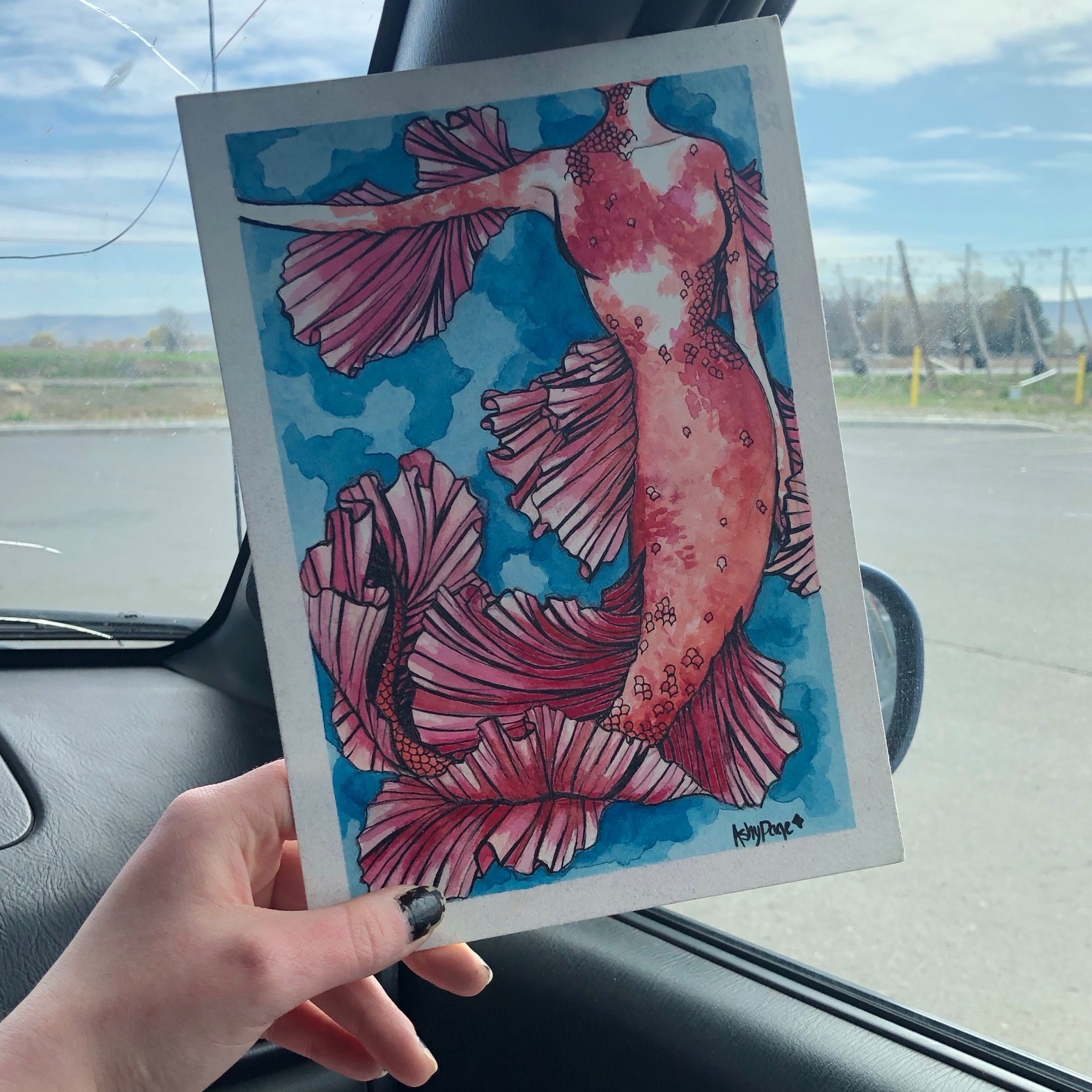
Tips on how to price your work are located further down, so feel free to skip pass my rambling if you’re just here for the info.
I can’t tell you how blown away I was by the responses I got the first time I asked for listing price opinions.
It was maybe 8:00AM and I had already been staring at my product listing page for about an hour before I finally realized there was no way I could accurately price this piece of mine. Frustrated and as far from decided as I could’ve ever been, I knew I needed to get something listed. Just to get me started, you know? But I had already spent weeks deciding exactly which of my original paintings would be the first one I listed for sale.
Sorting through probably a hundred —or so— different pieces, setting aside the ones that weren’t suitable for sale whatsoever. Paintings with uneven borders, pencil lines that wouldn’t erase and the paint didn’t completely cover, and obviously I couldn’t sell the ones I painted on the backside of previously failed projects, even if they did look flawless. Anyone buying my work deserved better than recycled paintings. If they weren’t perfect, they weren’t worthy.
Left with my smaller but still large pile of paintings to choose from, I raised my standards and started disqualifying paintings based on what sizes are usually preferred by other artists’ clients and fans, art collectors and enthusiasts.
The ones too small to fit into frames were definitely a no go, because I kept asking myself, “what would anyone even do with these tiny things?” And I kept giving myself the same answers… “Too small to display.” “If anyone wants something this small, I’m sure they would rather just buy one of my prints.” “The prints are going to be cheaper. You can do way more with a sticker than you can with a little scrap of paper.” If a painting was an odd shape or had unusual dimensions (like 6.5” wide, and nearly 18” long) then that was an automatic no.
I was narrowing the options down and didn’t realize that not only was I being unnecessarily and excessively critical of my work, but I was also being very closed minded about my customers, clients or audience would actually want. I’d forgotten that I could literally post just about anything on Etsy, and someone in the world would probably want it. It’s more a matter of that specific person finding the product than anything else.
However, a decision was eventually made. My final choice, “Betta”, a small watercolor and black ink painting —with slightly uneven borders.
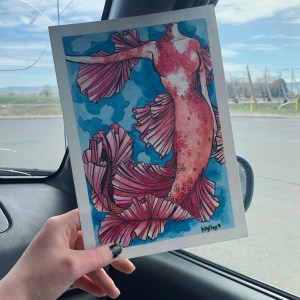
This was my first piece listed, for only $36, which I now realize, I could’ve given myself a little more credit. It can just be so difficult to trust that your artwork might be something people actually want to buy. And for some reason, no matter how good my paintings are, I feel like they’re not worthy enough. But to be a professional artist, you’ve got to start somewhere. So here are a few guidelines on how to price your artwork if you’re like me and have some doubts about your worth as an artist.
How To Price Your Work:
- Multiply the painting’s width by its length to determine the total size in square inches
- Then decide how much to charge per inch,
- Calculate your hourly rate
- Calculate the cost of materials such as the frame, canvas, paper, etc.
- Be honest about the quality of your work. And if you have a hard time determining how good your work is, ask opinions from people you know will be honest with you such as friends, family or even people on social media.
- Put it all together
As an example, we’ll say this is for unframed oil painting at $2 per inch, on a 10″x10″ canvas is $200. Add the cost of a canvas, which is probably about $9.99 and round that to $210, if your hourly wage is $16 an hour and you’ve spent 3 hours in total on this painting, you should charge $258 for your painting. Now, that price may seem high but if your work is absolutely fantastic, then you’re worth it and they might even be worth more. if you’re not at that level yet, just lower your cost per inch and your hourly rate. And you can always look for similar types of artwork, art styles and see what other people are charging, if that helps make it easier to make a decision. Good luck!

 Edgy Art For Outcasts